Sidebar tonen 
Alle activiteiten
Deze stream update zichzelf
Afgelopen uur
-
Een update voor wie via zoeken in dit topic terechtkomt: de pauze in de handhaving uit het bericht van februari 2025 is niet meer de actuele stand voor het hele assortiment. Op de huidige GPSR-pagina schrijft bol dat nieuw assortiment zonder fabrikantgegevens sinds 5 maart 2026 niet online komt, en zonder verantwoordelijk marktdeelnemer sinds 1 april 2026 niet. Vanaf 1 april worden ook bestaande artikelen in fases offline gehaald wanneer fabrikantgegevens ontbreken. Bron: https://partnerplatform.bol.com/nl/idp/gpsr Bol benadrukt daar bovendien dat eerder aangeleverde gegevens van de verantwoordelijk marktdeelnemer niet automatisch voldoende zijn: controleer per artikel ook de fabrikantgegevens. Voor de tweedehands boeken uit de oorspronkelijke vraag zou ik niet op basis van deze algemene update zomaar jezelf als verantwoordelijke invullen. Leg de concrete categorie en herkomst, met enkele voorbeeld-EAN’s, voor aan Partnerservice en vraag schriftelijk welke gegevens zij daarvoor verlangen. Maak onderscheid tussen je wettelijke rol in de keten en de velden die het platform ingevuld wil hebben.
-
Ik voeg voor latere lezers een bron toe, omdat de conclusie hierboven dat dit bij een eigen webshop niet hoeft, tot misverstanden kan leiden. De NVWA beschrijft dit op de algemene GPSR-pagina onder “Houd u aan de regels bij verkoop op afstand”: https://www.nvwa.nl/onderwerpen/productveiligheid/gpsr-productveiligheidsverordening/wat-betekent-de-gpsr-voor-mij Voor producten waarop deze regels van toepassing zijn, moeten in het online aanbod onder meer de fabrikantgegevens duidelijk zichtbaar zijn: naam, postadres en elektronisch contactadres. Zit de fabrikant buiten de EU, dan komen daar de gegevens van de verantwoordelijke persoon binnen de EU bij. Ook productidentificatie en de toepasselijke waarschuwingen/veiligheidsinformatie horen erbij. Dit betreft dus ook een eigen webshop, niet alleen bol of Marktplaats. Dat de informatie niet op de specifieke pagina voor distributeurs stond, betekent niet dat de algemene regels voor verkoop op afstand vervallen. Praktisch zou ik de leverancier de gegevens per product/EAN laten aanleveren en vervolgens controleren of ze daadwerkelijk zichtbaar zijn bij het juiste product. Controleer wel eerst of je product binnen de reikwijdte valt en of er specifieke uitzonderingen of sectorregels gelden.
-
Voor wie later op dit topic uitkomt: naast de fiscale uitleg hierboven zou ik een aparte aansluiting van de bol-afrekening maken. Daarmee kun je voorkomen dat je dezelfde kosten of verkopen twee keer verwerkt. Een eenvoudig controleblad kan deze kolommen hebben: ordernummer, verkoopbedrag, retour/correctie, ingehouden kosten, nummer van de bol-afrekening en bankuitbetaling. Houd daarnaast de eigen verkoopfacturen en de kostenfacturen van bol herkenbaar bij elkaar. De geldcontrole is dan: beginsaldo tegoed bij bol + ontvangen verkoopopbrengsten - retouren - verrekende kosten - uitbetalingen = eindsaldo tegoed bij bol. Neem eventuele overige correcties afzonderlijk op. Het eindsaldo hoeft rond de jaarwisseling dus niet nul te zijn. Dit controleblad bepaalt niet in welk btw-tijdvak een post hoort; daarvoor blijven de onderliggende stukken en het toepasselijke stelsel nodig. Het maakt wel zichtbaar welk verschil door timing komt en welk verschil door een ontbrekende of dubbele boeking. Leg de jaarafgrenzing vervolgens met dat overzicht aan je boekhouder voor.
-
Een aanvulling op de laatste reactie: ik zou de conformiteit van de verpakking en de gewichtsadministratie voor producentenverantwoordelijkheid apart controleren. Een overzicht van materiaalgewichten vervangt de conformiteitsverklaring en het technische dossier niet. RVO heeft hierover een Nederlandstalige Q&A, gecontroleerd op 24 september 2026: https://www.rvo.nl/onderwerpen/eu-wetgeving/verpakkingseisen-ppwr Daarin worden ook de verschillende rollen uitgelegd. Praktisch zou ik per verpakkingstype vastleggen: wat is de verpakking, wie levert haar, welke rol heb je zelf en welke documentatie hoort erbij? De productverpakking en de verzendverpakking zou ik daarbij afzonderlijk nalopen. Voor het oorspronkelijke voorbeeld met bestaande sproeikoppen zou ik de concrete keten en leverdata aan RVO voorleggen. Alleen het feit dat iets al op voorraad ligt, vind ik onvoldoende om voor iedere situatie te concluderen dat er niets meer hoeft te gebeuren. RVO biedt op die pagina ook een contactmogelijkheid voor zulke uitvoeringsvragen.
Vandaag
-
Thank you very much. I am daily using the business model canva. But the Value Proposition canvas, made a huge difference. Seems like instead of solving a problem, I am creating a new problem. I adjusted everything to remove this new problem. The lack of credibility and an offer of 30€ for three bottles create another problem "The wines are they any good ? Seems like it is constantly the same promise from every shops."
-
-
-
When I receive something in return for my answers (such as a detailed report on my taste profile) I feel much more inclined to take action, for instance, to make a purchase. Giving me that report is also a sign of trust towards me, because I can use that report to shop elsewhere. Offering something for free combined with trust and personal attention draws me into a psychological contract; that is a well-known sales technique. I think that would be an excellent intermediate step between the test and making a purchase offer. Perhaps you could send the report via email and suggest a second test for greater depth. At the very least, that generates repeat visitors to the website. Moreover, it gives people a choice: more information (luring them even deeper into the rabbit hole) or proceeding to a purchase.
-
Thanks a million for your feedback. Which has been much better than any physical feedback. That's very very interesting. Indeed wine is an experience. But we forget about the taste of the products. As a winemaker, I have made a lot of physical and online survey and the main reason people are turning their back to the wines is the disappointment from the taste. Secondly people feel stupid to ask a question about wine. While the quiz is simple to complete, each question targets specific daily food habits (like black coffee, citrus, or salt preference) that serve as proven biological markers for tannin sensitivity and acid tolerance. In Rotterdam, I have made some blind tasting to shoot some testimonials which are shown on the landing page at the result stage. Would you suggest me that I should give some explanation from the answers given by the customer before showing them the bottles that would match with their taste. You are pointing out it is exactly my point. I never give a taste description, because everyone has its own taste sensitivity. Coffee is a perfect example. It is funny how a simple industry is becoming more and more complexe. People drink coffee because most of the time they get what they expect. However, I know precisely the taste similarities between every wine. The quiz is the only subjective step of the website, because it relies on people answer. Then soon as people rate the wines, every single customers who bought wine from the taste similarities have been satisfied. The only negative rating a wine received was the most expensive bottle of my website that I have offered because I love it... which shows that taste is unique. Regarding your point on samplers: since shipping miniature formats isn't economically viable in our logistics (we only ship standard 75cl bottles, meaning an unavoidable ~€30–€35 threshold for 3 bottles), I have to bridge that trust gap digitally. From your perspective as a skeptical buyer: Would receiving an in-depth, educational breakdown of your biological taste profile right after the quiz (explaining why your palate matches these profiles), coupled with unedited videos of real people blind-tasting their kit, be enough to make that initial €30–€35 leap feel like a fair discovery rather than a sales trap?
-
scarlenl werd lid van de community
-
Hi Norbert, Thank you for moving the topic to the specific board. Here are the answers to the five mandatory questions: 1. Description of your concept: VinPop is a Dutch D2C wine e-commerce platform that matches bottles to individual taste profiles using lab molecular analysis. We never judge whether a wine is "good" or "bad" our algorithm calculates: "If you like Wine A, here is Wine B with an exact percentage of chemical taste similarity." 2. What have you done so far to develop this: - Background: Bordeaux winemaker (10 years) using oenological lab analysis for 7+ years to craft wines. - Tech & Industrial Validation: Taste-matching algorithm built with a partner lab whose profiling technology supports producers representing over 3 million bottles. Validated in Rotterdam blind tastings (participants couldn't distinguish between different wines sharing the same molecular profile). - Marketing & Testing: 6-question quiz onboarding, €5,000+ invested in Meta Ads. A past discount offer (€29.90 for 4 bottles) validated demand but attracted one-off bargain hunters. We recently redesigned the UX/UI toward a clean, data-driven experience with upfront transparent pricing. 3. What challenge are you trying to solve: The "wine guessing game" and wasted money. Consumers pick bottles blindly based on confusing labels, marketing, or subjective medals, regularly wasting €10–€25 on bottles they dislike and pour down the sink. Wine consumption is dropping because people find it overly complicated and intimidating. We remove that friction: the wine adapts to the drinker's biology. 4. How does this differ from existing solutions: Traditional shops, supermarkets, and apps (Vivino) rely on subjective crowd ratings, critic scores, or seller bias ("what others like"). VinPop is strictly objective. We measure precise molecular metrics (acidity, body, tannins, sweetness) to determine the exact similarity between wines. No forced subscriptions customers start with a 3-bottle Tasting Kit. 5. Feedback requested: - Funnel & CRO: Why 100% of Meta Ads visitors complete all 6 quiz questions, but drop off to 0% at checkout (€30–€35 cart). - Dutch Consumer Psychology: Is the jump from a free 60-second quiz to an upfront purchase too abrupt? Does the lab/data angle trigger trust or skepticism? - Value Proposition & Trust: How to effectively bridge the credibility gap so a first-time visitor feels safe ordering without having tasted the wine first. Website link: https://vinpop.nl (The 6-question quiz is on the homepage to see the results and checkout flow). Kind regards, Adrien
-
-
I've moved your question to this specific board in which you are allowed to place a link and screenshots if you are willing to answer the following five mandatory questions Omschrijving van je concept: Omschrijf wat je tot nu toe zelf gedaan hebt hiervoor: Wat is de uitdaging die je met je concept op wil lossen: Hoe is dit anders dan bestaande concepten: Wat voor feedback hoop je te krijgen: Or in English Description of your concept: Describe what you have done so far to develop this concept: What challenge are you trying to solve with your concept? How does your concept differ from existing solutions? What kind of feedback are you hoping to receive? Kind regards, Norbert, Forum Moderator
-
KVTokobaas werd lid van de community
-
Welcome to Higherlevel. In my opinion no flavour in wine is worth more than €5 a bottle. The rest of the value comes from the experience: the bottle, the label, the shopping experience, the anticipation, and even the price you paid. Selling wine online strips away much of that experience. And now you're making the process even more technical with lab tests, a quiz, and a cleaner user interface. So I'm not surprised people aren't jumping from a free online quiz to spending €30–40. You've stripped away much of the perceived value without giving people enough reason to trust what's left. The underlying issue, in my opinion, is therefore (lack of) trust versus a (high) spending threshold. Based on your description, I'm sceptical that you can recreate that sense of discovery and personal connection online. But you could, for example, show a video of real people going through the quiz, receiving their recommendations, tasting the suggested wines, and sharing their honest reactions. Let people see the process in action, not just hear you explain how it works. That would make the experience feel human, personal, and tangible. More importantly, it would provide social proof that the recommendations actually work for real people. I might then think: Maybe this works for me too. Maybe I should give it a try. Don't give me the feeling that I'm lured into a sales funnel and this is just a trick to sell me stuff. If I'm not convinced your product works (only 6 questions?), I'm certainly not going to spend good money just because you tell me to. I have the same problem with coffee beans. The flavour profiles described by sellers often turn out to be wildly inaccurate. I don't want to buy a kilogram of beans only to discover after one cup that I hate them, and yes that has happened more often than I'd like to admit. What I want is a cheap(er) way to experiment: small samplers, recommendations from people who I can relate to.
-
Adrien VINPOP wijzigde zijn profielfoto
-
-
-
-
Hoi, Ik ben momenteel gestopt met verzenden binnen de EU vanwege de nieuwe PPWR, maar ik loop bestellingen mis en zou graag tenminste weer naar België willen gaan verzenden. Ik snap dat je je bedrijf moet gaan registreren bij Fost Plus en ik heb met hun ook al contact gehad maar ik vind de informatie rondom de verwachte kosten nogal een beetje vaag (zie hieronder): Registration and Costs with Fost Plus Every producer (including foreign webshops shipping to Belgian consumers) must register in the Belgian national producer register for packaging under the PPWR. If you become a member of Fost Plus, Fost Plus will handle the registration process for you at no additional cost. You do not need to take individual steps; all administrative aspects are managed collectively for members. Thanks to this collective approach, the five-yearly registration cost charged by the government is reduced to €100 per year per member, instead of €1,500 for individual registration. This registration cost will only be invoiced starting from the calendar year 2027. In addition to the registration cost, you will pay an annual contribution based on the actual weight and type of packaging you place on the Belgian market. For small volumes like yours (50–80 packages per year, each 120g), this contribution will be very limited, but the exact tariffs are not specified in the context. The government may introduce additional costs, but these will only become clear after the summer. Fost Plus invoices only based on the quantities you declare. 2. Requirement for a Local (Belgian) Authorised Representative As a foreign producer (not established in Belgium), you are required by the PPWR to appoint an authorised representative for EPR who is established in Belgium, starting from 12 August 2026. Fost Plus and Valipac will NOT act as your authorised representative. You have to contact the European Commission: +32 2 299 11 11 Ik heb ook gezien dat er een bericht is geweest dat de EU landen heeft gevraagd om mensen niet te beboeten maar eerst te waarschuwen, en dat er wordt gewerkt aan een betere oplossing voor kleine bedrijven maar dat niemand echt weet wat en wanneer er iets gaat gebeuren. Ik zie online ook dat er bedrijven zijn die gewoon als 'normaal' doorgaan en hopen op het beste maar ik weet niet of dat de beste weg vooruit is Ik zou graag willen weten of er hier kleine bedrijven zijn die naar Belgie versturen en hun ervaring kunnen delen? Wie heeft er een lokale vertegenwoordiger en kan vertellen wat de kosten hiervoor zijn? Alvast bedankt! Tina
-
Hi everyone, I’m a Bordeaux winemaker building a wine-tech e-commerce platform for the Dutch market. I’m currently hitting a critical funnel bottleneck and would love direct feedback from experienced founders. (If allowed by moderators, I’ll gladly share the link or screen recording in the comments. I'm not here to promote, just trying to fix my checkout drop-off). --- ### The Problem We Solve Buying wine is usually a gamble based on marketing, confusing labels, or medals. The result? Consumers regularly waste €10–€25 on bottles they dislike and pour down the sink. When people dislike a wine, the industry often implies: "You just don't have the palate." In reality, taste is subjective. Our value proposition: "Never pour a bottle down the sink again." We replace subjective ratings with objective lab data. --- ### The Concept As a winemaker, I’ve used laboratory molecular analysis for over 7 years to craft my own wines. We apply that same precision to consumer taste: 1. Step 1 (Tasting Kit): Customers take a 6-question quiz. Our algorithm maps their profile against 100 molecular criteria to recommend a 3-bottle kit. 2. Step 2 (Calibration): They taste at home and rate each bottle (Love / Like / Dislike). 3. Step 3 (Predictive match): Ratings calibrate future selections based on chemical similarity (from safe matches to new flavor adventures). --- ### The Bottleneck & Past Test Currently, 100% of traffic comes from Meta Ads. The top of the funnel converts well: 100% of visitors who start the quiz finish it. But once they reach the checkout page showing their 3 matched wines and the cart total (~€30–€40), conversion drops to 0%. Past experiment: A few months ago, I tested an entry offer (€29.90 for 4 bottles, €50 retail value, free shipping). It converted very well, but attracted pure bargain hunters with near-zero retention. Unit economics were unsustainable, so I stopped it. --- ### Recent Changes (UX) We redesigned the checkout to look like a clean, data-driven lab experience: - Clear taste profile comparison sliders per bottle (quiz answers vs. lab molecular data). - Prominent, active dark checkout button. - Transparent pricing (free shipping applied upfront on the first kit). Still, no purchases. As a founder, the lack of sales is 100% my responsibility. --- ### Questions for the community: 1. Value Proposition: Does the lab-data matching (% match + molecular sliders) feel like legitimate personalization, or does it trigger skepticism / look like a gimmick? 2. Price Transition: Is moving from a free 60-second quiz directly to an upfront €30–€40 cart too abrupt for first-time visitors? 3. Offer Structure: How would you balance sustainable gross margins without scaring off buyers who haven't tasted the wine yet? Any insights from founders running quiz-funnels or physical B2C products would be hugely appreciated! Thanks, Adrien
-
Adrien VINPOP werd lid van de community
-
-
… te meer omdat veel ZZP’ers, en misschien wel allemaal, de zakelijk rekening verontreinigen met allerhande privé transacties. Hoe maak je het onderscheidt zonder facturen? Dat haal je niet uit de betaalomschrijving. Uit ervaring kan ik mededelen dat menig ZZP’er het presteert om boven de 60% aan privé transacties uit te komen … en nee, opvoeden lukt al jaren niet, ook niet als ze voor de verwerking extra voor moeten betalen.
-
Goedemorgen, Je geeft aan dat je doormiddel van een bankafschrift import een compleet financieel beeld hebt? Hoe kan je bank het volgende weten: Verkoopfacturen die jij verstuurd hebt maar nog niet zijn ontvangen? (BTW moet je wel afdragen) Hoeveel BTW je uit je inkoopfacturen mag halen ( hoog/laag/EU etc.) Op basis van welke omschrijving doe jij bepaalde kosten / opbrengsten rubriceren? Lijkt mij voor veel ZZP'ers niet heel werkbaar...
-
Hoi allemaal, Als boekhouder vertelden nieuwe klanten me steeds hetzelfde. Hun vorige boekhouder deed de btw-aangifte netjes, maar een tussentijds overzicht kregen ze niet. Dus hielden ze hun cijfers zelf bij in Excel, en dat bestand liep altijd achter en gaf niet het complete financiële overzicht. Daarnaast zie ik veel startende én ervaren ondernemers tegen hetzelfde aanlopen: ze weten pas hoeveel btw ze moeten betalen als hun boekhouder het vertelt, en dan is dat geld vaak al uitgegeven. Daarom heb ik een tool gebouwd voor compleet financieel overzicht. Je importeert een CSV van je bank, je transacties worden automatisch gecategoriseerd en je ziet direct je omzet, kosten, winst en hoeveel btw je ongeveer opzij moet zetten. Daarnaast houd je openstaande facturen, projecten, uren en kilometers bij. Graag jullie eerlijke mening over: 1. Is binnen tien seconden duidelijk wat het is en voor wie? 2. Zou je hiervoor je eigen Excel loslaten? Zo nee, waarom niet? 3. Wat zou je ervoor willen betalen? 4. Wat mis je? Alvast bedankt, ook voor de harde feedback.
-
Jessesneekes werd lid van de community
-
Fitabugh werd lid van de community
Gisteren
-
“Ex-medewerker Belastingdienst luidt de noodklok, maar is geen klokkenluider” De klok luidt al zolang dat niemand daar nog enige notie van neemt. … en het is nog veel erger, want het is diezelfde Overheid die allerlei obscure wetten en regels introduceert om de belastingkraan open te houden, maar niet actief aan het werk wil gaan om geld binnen te harken wat minder vloeibaar is. Je zou toch denken dat belastinginning een maatschappelijke plicht is.
-
Het begint met een idee … zeg maar “ik heb een plan” … maar geen uitgewerkt plan op papier … en dat leg je voor aan je vriend, je partner, je echtgenoot, want samen ben je slimmer, samen kom je verder. Alleen reis je sneller, maar het gevaar bestaat (of de kans zoals je wilt) dat je struikelt over je eigen snelheid of dat je de verkeerde afslag neemt. In overleg bepaal je de richting en de manier van reizen die je samen hebt gekozen. En dan het ondernemen of dat maatschappelijke waarover wordt geschreven. Het is in eerste instantie geld verdienen voor je eigen onderhoud, daarna reis je in een richting die bij je past. De lucht is overal blauw, maar loopt slechts daar waar jij je thuisvoelt. Dat thuisvoelen is iets wat je niet in je eentje doet, en daarmee komt het maatschappelijke aspect al snel om de hoek kijken. Met geld kan je niet alles kopen … niet alles is in geld uit te drukken. Niks filosofisch, niks dromerig, maar met een of twee paar stevige benen op de grond staan. Maatschappelijk ondernemen bestaat in wezen ook niet … want ondernemen heeft ergens en altijd een maatschappelijk raakvlak.
-
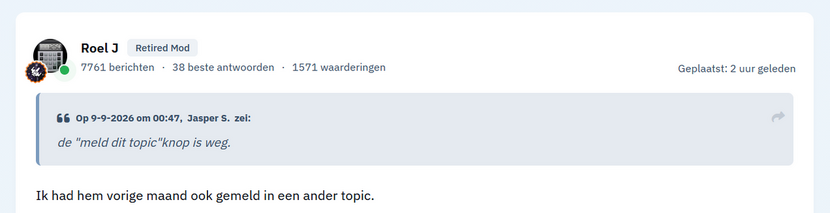
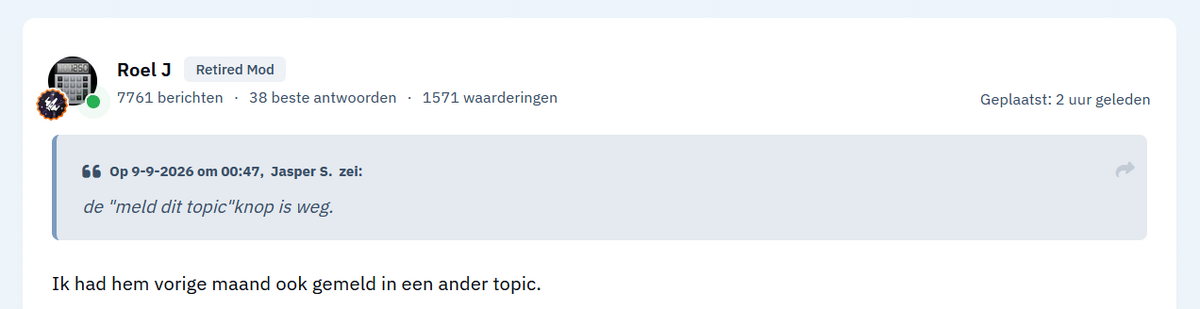
Nu ik dit antwoord heb geplaatst zie ik de meatballs wel bij het nieuwe bericht, samen met de wijzig optie. maar in mijn eerdere reactie van ca 2 uur geleden is het weer weg. Dus dat verdwijnen komt vermoedelijk doordat je na 120 minuten je reactie niet meer mag wijzigen. niet alleen de wijzig optie verdwijnt maar het hele menu